Non-UK Registered Casinos: Regulation and Risks
Company location, licensing and UKGC oversight are different things, with practical implications for player protections and payments.
 Available in GB

- What “Non-UK Registered” Actually Means
- Not on GamStop: What That Means for You
- The Legal Position for Players in Britain
- Curaçao Casinos and Gamban: Don’t Confuse the Terms
- What a UK-Registered Online Casino Has to Have
- Anjouan Licences: Check the Limits Before You Trust One
- Gamban and Offshore Casino Safeguards
- Payments at Non-UK Casinos: The Routes You May See
- A UK-Registered Casino and the Protection You Give Up Offshore
- Recommended online casinos
- Withdrawals, Bonus Terms and the Risks Hidden in the Small Print
What “Non-UK Registered” Actually Means
“Non-UK registered” is a phrase people use for online casinos that do not operate under the oversight of the UK Gambling Commission (UKGC). It can sound as though the casino has simply registered a company abroad, but that is not the distinction that matters here. The useful question is whether the operator holds a UKGC licence and is regulated by the Commission.
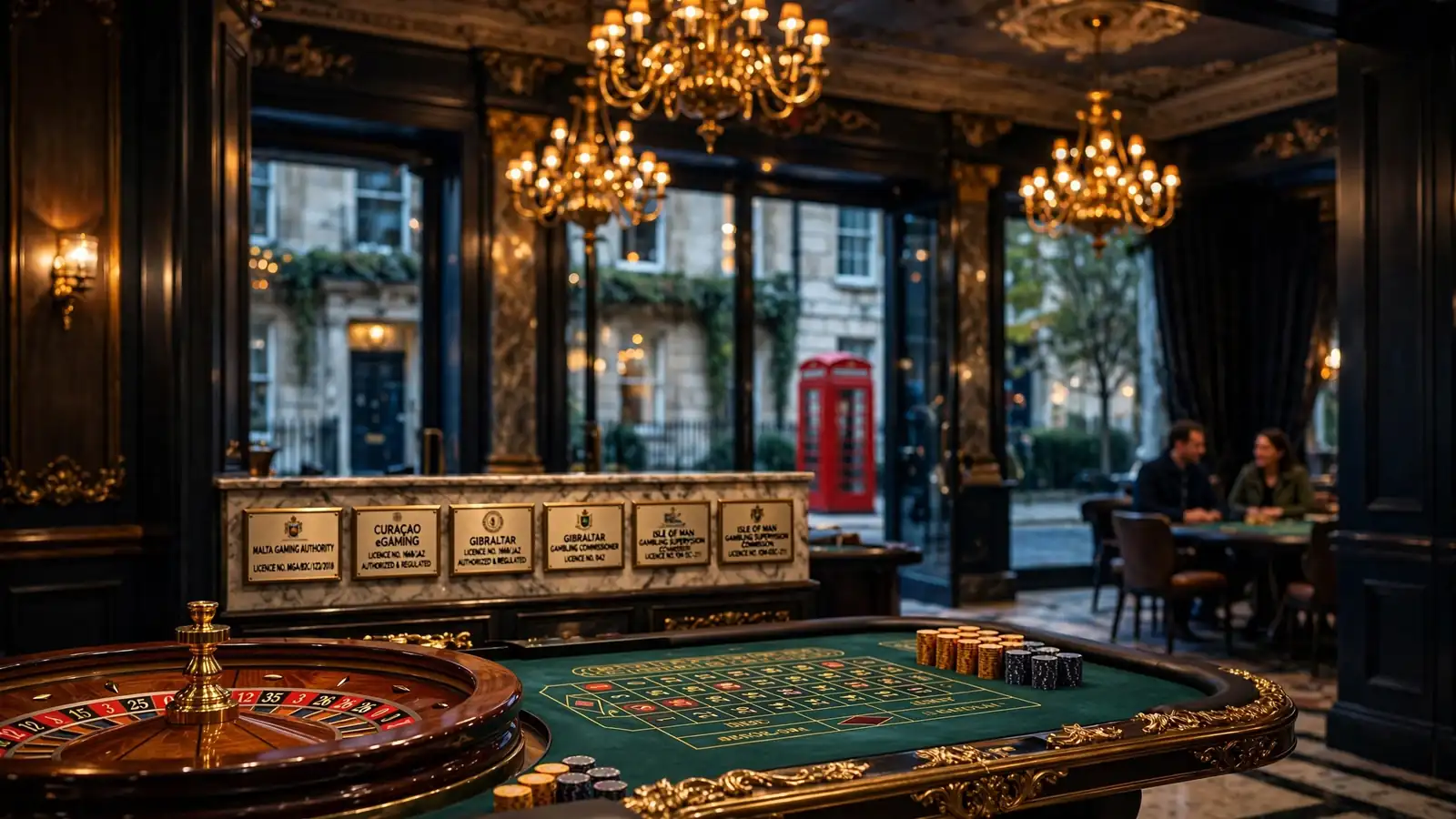
A casino may be based in one country and licensed by a regulator in another. Non-UK-regulated casinos are commonly associated with licences from places such as Malta, Curaçao, Gibraltar or Anjouan. That licence tells you which authority oversees the operator under its own rules. It does not make the casino UK-regulated, even if the site is easy to reach from Britain or displays a familiar-looking licence badge.
I find it helps to separate three ideas that often get muddled: where a company is based, where it holds a licence, and which regulator oversees its gambling service. Those details can point to different places. A company’s address is not, by itself, proof of the licence it holds; equally, a foreign licence is not a UKGC licence. “Non-UK registered” is everyday shorthand, not a precise description of a company’s legal structure.
Licence and location are not the same
A non-UK-regulated casino operates without UK Gambling Commission oversight. It may still be licensed elsewhere, so “not regulated by the UKGC” does not necessarily mean “has no licence anywhere”. The regulator named by the casino may be Malta’s, Curaçao’s, Gibraltar’s or Anjouan’s authority. Each is a separate jurisdiction, and its licence belongs to that regulatory system.
That distinction matters when you read a site’s footer or terms. A foreign regulator’s name can tell you that the operator claims a connection to that jurisdiction; it does not change the identity of the regulator responsible for the casino. A logo on a page is not the same thing as UKGC oversight. Nor does a company’s use of a UK-facing name or British currency settle the question.
Non-GamStop European Casinos: UK Player Guide
The word “registered” can also confuse matters. People may use it to mean “licensed”, “listed with a regulator” or simply “set up as a business”. Those are not interchangeable. For this topic, the clearest wording is usually “UKGC-licensed” when talking about casinos overseen by the Commission, and “non-UK-regulated” when talking about sites that are not.
Why the operator’s base can mislead
An operator does not become UK-regulated just because it has an office or company registration in Britain. The reverse is also true: a business being based abroad does not, by itself, tell you which licence governs its gambling operation. The location of the company and the regulator responsible for its casino are separate pieces of information.
There is an important UK-side reference point: operators serving customers in Great Britain need a UK Gambling Commission licence, wherever they are based. So a casino’s overseas address does not explain away the absence of UKGC oversight. When you see claims about an international licence, read them as claims about that other regulator, not as a substitute label for a UKGC licence.
This is why I would not treat “foreign”, “international” and “non-UK registered” as exact synonyms. They may be used casually to describe much the same group of sites, but they do not reliably tell you the company’s location, its licensing jurisdiction or the scope of its oversight. “Non-UK-regulated casino” is more direct: it describes the regulatory distinction rather than guessing where the business is incorporated.
A practical way to read the label
When a site calls itself licensed, look at the wording around the licence and identify the authority it names. Is it the UK Gambling Commission, or a regulator in another jurisdiction? That is the basic distinction behind searches for non-UK registered casinos in 2026. The year does not change what the phrase means: the central point is whether UKGC oversight applies.
If the named authority is outside the UK, describe the site accordingly: it may be licensed overseas, but it is not thereby UKGC-regulated. Keep that wording in mind when comparing a non-UK-registered online casino with one that holds a UKGC licence. The two labels refer to different oversight arrangements, even if the sites look similar at first glance.
"Non-UK registered" generally means the casino operates outside the oversight of the UK Gambling Commission (UKGC), though it may still hold a license from another jurisdiction such as Malta, Curaçao, Gibraltar, or Anjouan.
It is also worth avoiding the shortcut “not registered with GamStop” as a definition of a non-UK-regulated casino. That phrase concerns a separate scheme, not the regulator that issued a gambling licence. The two ideas are often bundled together in casual conversation, but one does not define the other. For now, keep the categories separate: identify the gambling regulator first, then consider any other scheme or service mentioned by the site.
The short version is simple: “non-UK registered” usually means the casino is outside UKGC oversight, not necessarily that it lacks any licence. Find the regulator it names, and do not confuse that jurisdiction with the UK Gambling Commission. A label is only a starting point.
Not on GamStop: What That Means for You
If you have excluded yourself through GamStop, the important point is simple: that exclusion applies to participating operators, not to every gambling site you can reach. A casino operating outside the scheme does not receive the exclusion in the way a GamStop-connected operator does. So it should not be treated as an extension of the block you have already put in place.
That distinction matters more than the label on a website. A site might describe itself as an online casino not registered with GamStop, or as a non-UK casino, but the practical question is whether it is included in GamStop’s self-exclusion system. If it is not, your existing exclusion does not provide the same barrier there. The name can sound reassuringly familiar; the coverage is not the same.
Online Casinos With No Registration in the UK
What self-exclusion does — and does not do
GamStop is the UK Gambling Commission’s self-exclusion scheme. Online casinos outside it are not connected to that scheme, so a person who has self-excluded cannot assume that the exclusion will prevent them from opening or using an account at one of those sites. Put plainly, choosing a site that is outside GamStop means the exclusion may not follow you there.
I would not read “not on GamStop” as a technical detail to skim past. For someone who signed up because gambling had become difficult to control, it changes the practical value of that decision. The protection is not universal. It depends on the operator being part of the scheme.
This is also why searches for live casinos not registered with GamStop, new sites, or the best online casinos outside the scheme can point in a direction that is at odds with a self-exclusion decision. The wording may sound like ordinary shopping around, but the underlying issue is whether you are looking for somewhere the restriction does not apply. If you chose self-exclusion to put distance between yourself and gambling, that distance can be reduced when you move to a site outside the scheme.
No clever wording changes that. A site’s description, game selection or live-dealer format does not make it part of GamStop. Nor does calling it “safe” or “reputable” answer the self-exclusion question. Those labels are not a substitute for the specific protection you enrolled in.
Self-Exclusion Gap
If you have excluded yourself through GamStop, this protection does not apply to operators outside the scheme; your existing exclusion will not prevent you from opening or using an account at such sites.
The protection gap
The gap is not only about whether you can register. When you gamble with an offshore operator, you also give up access to the UK’s Financial Ombudsman Service and the mandatory responsible-gambling tools associated with UK-regulated operators. In practice, that means you cannot assume that the same safeguards and routes for help will be available if you have a problem.
That is worth considering before depositing, not after a difficult session. A self-exclusion choice is meant to create a boundary. If you move to an operator outside the scheme, you may be relying on your own ability to maintain that boundary instead of on the scheme applying across the site. That is a substantial difference, even if the casino’s website looks polished and the account process feels routine.
I would be wary of treating a list of “top” or “best” casinos not registered with GamStop as a safety ranking. A ranking can describe preferences or features, but it cannot make an excluded operator part of GamStop, and it cannot restore the protections that come with that scheme. In particular, a recommendation does not tell you that your self-exclusion will apply there. That is the detail to keep in view.
If you have self-excluded because you are trying to stop gambling, searching for a new online casino outside GamStop may undermine the reason you enrolled. Pause before opening an account. Consider whether you want to gamble at all, rather than simply whether a particular site accepts you. That is not a lecture; it is the practical consequence of a scheme that does not cover every operator.
Casino No ID Verification in the UK: What It Means
A check worth making before you act
Ask yourself what you expected GamStop to do. If you expected it to prevent access to all online gambling, a non-GamStop site does not meet that expectation. If you enrolled to make gambling harder to reach, looking for casinos beyond the scheme can remove part of that barrier.
People often use phrases such as “online casinos not registered in the UK” and “casinos not registered with GamStop UK” as if they described one straightforward category. For this decision, the key point is narrower: a site outside GamStop is not covered by your GamStop exclusion. The UK-facing safeguards that you lose offshore are a separate part of the same practical picture, not a reason to assume the exclusion will somehow carry over.
I would keep the decision grounded in that difference, rather than in claims that an offshore casino is the best, newest or safest option. None of those claims changes whether GamStop applies. If you have already chosen self-exclusion, treat that choice as meaningful and be cautious about seeking a route around it. The boundary matters.
The Legal Position for Players in Britain
When you look at casino sites not registered in the UK, two separate questions can easily get tangled: whether the operator is authorised to serve customers in Great Britain, and whether a British player commits an offence by using the site. The law draws a distinction between those positions. The operator’s obligations are not automatically the player’s criminal liability.
Do
- Distinguish between the operator’s permission to serve a market and the player’s legal position.
- Understand that using an overseas-licensed service is not explicitly prohibited for British citizens.
Don’t
- Assume a foreign license is a substitute for UKGC oversight.
- Believe that a site accepting your registration proves the operator has permission to operate in Great Britain.
The Gambling Act 2005 is directed at businesses that provide gambling services into the British market. It is the operator, rather than an individual customer, that must meet the rules applying to supplying those services. A casino may be based abroad, but its location does not by itself settle whether it is authorised to serve people in Great Britain.
That does not mean every overseas service is authorised for British customers. An overseas licence is not a UK Gambling Commission licence, and the fact that a website accepts a player’s registration does not establish that the operator has permission to offer gambling in Great Britain. These are different questions: where the operator holds a licence, what market it is serving, and whether it has the authorisation required for that market.
For players, the key point is narrower. UK law does not explicitly ban British citizens from using gambling services licensed in other countries. In addition, a person who gambles on a site without a UK licence does not, on that account alone, commit a criminal offence under UK law. That is not the same as saying the site is approved in Britain, or that its operator is complying with British requirements.
Player liability and operator permission
I find it useful to separate the issue into two parts. First, the rules governing an operator that supplies gambling to customers in Britain. Second, the legal position of the person who places a bet. The fact that an operator may lack the local authorisation needed to serve the market does not turn the customer into the operator, nor does it make the customer’s use of the site a criminal offence.
Online Casinos with No Sister Sites in the UK
This distinction matters when people search for a casino not registered with GamStop or an online casino not registered with GamStop. The absence of that connection tells you something about the service’s relationship with the UK self-exclusion scheme; it does not answer the legal question by itself. Nor does it prove that an overseas operator is authorised to provide gambling in Great Britain. Those points should not be folded into one another.
The same applies to phrases such as “new casino sites” or “Curaçao casino sites” that may appear in descriptions of gambling services. A jurisdiction named on a licence tells you where the operator’s permission comes from. It does not replace the separate question of permission to serve British customers. The player-liability point remains distinct: using an overseas-licensed service is not explicitly prohibited for British citizens, and gambling on an unlicensed site does not itself make the player a criminal under UK law.
That is a limited statement, not a recommendation. “Not a criminal offence for the player” does not mean “licensed in Britain”, “approved by a UK regulator” or “covered by the same rules as a UK-licensed casino”. A UK casino not registered with GamStop may be described in informal terms, but that wording should not be taken as proof that the operator has the authorisation required for the British market. Likewise, searching for the best casino sites not registered with GamStop does not change the legal distinction between the customer and the business.
Attention: While gambling on an unlicensed site does not make a player a criminal under UK law, this does not mean the operator is authorized to serve the British market or that the site is approved in Britain.
What this does not settle
A player’s lack of criminal liability does not grant an operator permission to supply gambling services in Great Britain. It also does not turn an overseas licence into a UK licence. An operator’s regulatory position and a customer’s position under criminal law are separate matters, even when they concern the same account and the same bet.
It is worth keeping that separation in mind if you encounter claims about casino sites not registered with GamStop UK, slot sites not registered with GamStop, or casino sites not registered with Gamban. GamStop and Gamban are not terms for a gambling licence, and neither phrase answers whether the operator is authorised for the British market. The legal question here is about the player’s liability and the operator’s role in supplying gambling, not about what a site calls itself.
So the practical reading is straightforward: British law does not explicitly prohibit a person from using a gambling service licensed abroad, and the player does not commit a criminal offence merely by gambling on a site that lacks a UK licence. At the same time, that does not establish that the operator is permitted to serve Great Britain. One point concerns the customer; the other concerns the business. Keep them separate.
Curaçao Casinos and Gamban: Don’t Confuse the Terms
Curaçao is one of several jurisdictions associated with non-UK-regulated casinos. Malta, Gibraltar and Anjouan are also among the places where such operators may be licensed. That tells you something about the operator’s licensing jurisdiction; it does not tell you whether a particular site is covered by GamStop or blocked by Gamban.
Those are separate questions. A licence is an authorisation from a gambling regulator. GamStop is the UK Gambling Commission’s self-exclusion scheme, while Gamban is a blocking tool. Neither a Curaçao connection nor a casino’s licensing label, on its own, settles whether Gamban will block that site. I wouldn’t assume the answer either way.
It is easy to muddle the names because both GamStop and Gamban are discussed in connection with keeping away from gambling sites. But they do different jobs. A site being outside GamStop does not mean it is “registered with Gamban”; Gamban is not a register for casinos to join. Likewise, seeing Curaçao in a casino’s licensing information does not establish its status in either service.
If you are checking a specific site, keep the checks distinct. Find out which jurisdiction the operator says licenses it, then check your own self-exclusion arrangements separately. If you use Gamban, do not treat a casino’s licence details as proof that the software blocks it. A licensing claim and a blocking result are not interchangeable evidence.
That distinction matters most if you are trying to avoid gambling, rather than simply identify where a casino is licensed. Do not use the presence of a Curaçao licence as a shortcut for deciding whether a site is accessible through a blocking tool, or whether it falls within a self-exclusion scheme. The labels answer different questions.
Difference between GamStop and Gamban
GamStop is the UK Gambling Commission’s self-exclusion scheme for participating operators, whereas Gamban is a blocking tool. A site being outside GamStop does not mean it is registered with or blocked by Gamban.
I’d also avoid reading too much into a site’s wording. “Curaçao casino” describes a claimed licensing connection, not a promise about GamStop or Gamban. “Not on GamStop” is not another way of saying “not blocked by Gamban.” Keep the terms separate, and check the relevant service directly if access restrictions matter to you. Licensing and blocking are different levers.
What a UK-Registered Online Casino Has to Have
“UK-registered” can sound as if a casino simply needs a British company address or a place on a business register. For online gambling, the practical test is different: an operator serving customers in Great Britain needs a licence from the UK Gambling Commission. Where the company is based does not change that requirement.
That distinction is easy to miss when a site describes itself as British, uses sterling, or looks familiar. Those details do not establish that it holds the authorisation needed to serve the Great British market. The licence is the point to focus on; a company’s location is not a substitute.
I’d treat “UK-registered online casino” as everyday shorthand, not a precise description of the legal status. A casino’s operator may be based in Great Britain or abroad. Either way, if it serves customers here, it needs the relevant UK Gambling Commission licence. A foreign base does not create an exception.
What the label should tell you
When you see a claim that a casino is UK-registered, ask what the claim actually refers to. It might describe where a company is incorporated, where a website is aimed, or the operator’s regulatory authorisation. Those are not interchangeable. For a casino serving Great Britain, the relevant question is whether its operator holds a UK Gambling Commission licence.
That is a cleaner way to assess the label than relying on the site’s design or wording. A polished UK-facing website can still leave the key point unclear. So can a British address presented without explaining what it belongs to. The operator’s base and its permission to serve customers in Great Britain are separate matters.
This is also why the word “registered” can be misleading on its own. It suggests a simple administrative tick-box, when the important distinction is the operator’s licence for the market it serves. I would not read a British-sounding name, local currency, or UK-focused presentation as proof of that authorisation.
The rule is based on who the operator serves, not simply on where it operates from. That gives you a useful reference point when comparing a UK-facing casino with a non-UK-regulated one: the latter does not become authorised for Great Britain just by accepting British customers or presenting itself as local.
Keep the check narrow. Look for a clear statement about the operator’s UK Gambling Commission licence, rather than treating “UK-registered” as proof by itself. The wording may be casual; the authorisation question is not. A UK address is not the same thing.
Anjouan Licences: Check the Limits Before You Trust One
An Anjouan casino licence tells you something about the operator’s claimed licensing framework. It does not give the casino permission to serve customers in the United Kingdom. Anjouan’s rules also exclude other restricted markets, so seeing a licence badge is not the same as seeing UK authorisation.
An Anjouan license does not grant a casino permission to serve customers in the UK, nor does it require the operator to integrate with GAMSTOP.
That distinction matters when you are weighing up a site described as a trusted casino not registered with GamStop. “Trusted” is not a regulatory status, and an Anjouan licence does not make the casino part of the UK system. Treat the licence as a limited piece of information about the operator, not as a guarantee that you will have the protections available through a UK-licensed service.
The same care applies when listings group Anjouan sites with Curaçao casinos that are not registered with GamStop. Curaçao and Anjouan are separate licensing jurisdictions. A label that mentions one does not tell you which rules apply to another, and you should not assume that a claim about a Curaçao licence also describes an Anjouan casino.
There is a practical gap around self-exclusion and disputes. An Anjouan-licensed casino is not required to connect to GAMSTOP, and its licence does not oblige it to offer an independent dispute-resolution service comparable to one approved for UKGC-licensed operators. If you have a complaint, you cannot treat the UK route as a fallback simply because the casino has a foreign licence.
Anjouan’s framework does require operators to respond to complaints within 30 calendar days. That is a requirement to reply, not a promise that an independent body will decide the dispute in your favour—or decide it at all. The Anjouan authority does not handle, mediate or adjudicate individual player complaints.
Before relying on any licence claim, check that the public register entry, expiry date and company name match the operator you are looking at. A logo on a page is easy to display; the details need to line up. Even then, a valid Anjouan licence does not change the limits above: it does not authorise the casino to operate in the UK, require GAMSTOP integration or provide a UKGC-comparable independent appeal route. That is the part worth keeping in view.
Gamban and Offshore Casino Safeguards
“Registered with Gamban” can sound as though a casino has passed a safety check. It is better not to read that meaning into the phrase. Gamban and a casino’s own rules are separate matters, and the presence or absence of a connection between them does not tell you how responsibly the operator handles gambling or personal information.
I would treat claims about a site’s relationship with Gamban cautiously. They do not, on their own, establish what the operator does to limit harm, protect account data or deal with a player who wants to stop. Nor should you assume that Gamban blocks, or does not block, a particular non-UK-regulated casino. That is a separate question from the standards the casino itself follows.
The more practical concern is the operator’s safeguards. Non-UK-regulated casinos may apply less stringent responsible-gambling and data-protection rules than casinos licensed by the UK Gambling Commission. “May” matters: practices can differ between operators, so a general label is not a reliable description of every site. But you should not assume that the protections familiar from a UK-licensed casino will be present offshore. A safety claim in promotional copy is not the same as a clear, usable policy.
Verifying Offshore Safeguards
- Locate the privacy policy to see how personal data is collected and shared.
- Identify how to raise a concern regarding your data.
- Check for concrete responsible-gambling controls rather than broad promises.
- Verify if the operator’s safeguards match UKGC requirements.
Before sharing personal details, look for a privacy policy that explains what information is collected, how it is used, and who it may be shared with. Check whether the operator explains how to raise a concern about your data. For gambling safeguards, look for concrete controls and clear instructions, not just broad promises about responsible play. If the terms are hard to find, vague or inconsistent, that leaves you with less to judge the operator by.
This is especially easy to miss when a site presents a third-party tool as though it were part of the casino’s own protection. It is not a substitute for understanding the operator’s policies. Equally, a casino’s statement that it supports responsible gambling does not establish that its safeguards match UKGC requirements.
So, when you see a claim about Gamban, keep it in its lane. It cannot settle questions about a casino’s data practices or the strength of its player protections. Read those separately, and do not treat an offshore operator’s assurances as equivalent to UK oversight. A neat badge proves little.
Payments at Non-UK Casinos: The Routes You May See
At a non-UK registered casino, the cashier may offer a mix of familiar and less familiar ways to fund an account. Credit cards, e-wallets and bank transfers can appear alongside cryptocurrency, with transactions sometimes handled by payment processors rather than directly by the casino. So the name on a transaction may not match the site you visited. Check the payment details before confirming; surprises are not a useful feature of a cashier.
Credit cards need particular care in Britain. UK rules ban credit-card-funded gambling, while crypto payments can bypass that restriction because they do not use a credit card in the same way. That does not make crypto a safer or more suitable choice. You still need to understand how the payment works and what risks come with using it.
E-wallets and bank transfers are other possible routes. Their availability can depend on the casino and the processor it uses, so do not assume that a method you have used elsewhere will be offered here. Nor should you take a payment button as proof that the same route will be available for every later transaction.
You may also come across claims about deposits charged to a mobile phone bill or taken from a prepaid balance. A specialist review has described these options, but they should not be treated as a standard feature across non-UK casinos. Check the operator’s own cashier and terms to see what is actually available, and what conditions apply.
Before paying, look at the currency, any fees shown, and the payment provider’s terms. Keep a record of the amount and the confirmation. Most importantly, check the rules that apply where you live and consider the implications of using an offshore gambling service. A payment method being offered does not tell you whether the service is authorised to serve you, or settle any questions about your local legal position.
Attention: When using non-UK casinos, be aware that the name on a transaction may not match the site name if payment processors are used, and crypto payments may be used to bypass UK credit-card funding bans.
A UK-Registered Casino and the Protection You Give Up Offshore
The practical difference between a UK-registered casino and a non-UK-regulated casino becomes clearest when something goes wrong. With a UK-licensed operator, you have access to the protections built around the British system. If you play offshore, you give up access to the UK’s Financial Ombudsman Service and the responsible-gambling tools that UK rules require.
That matters before a dispute ever starts. Mandatory tools can help you set boundaries around gambling, including limits and self-exclusion options. At an offshore site, you cannot assume those safeguards will be available or work to the same standard. You may see controls on the account, but their presence is not the same as having UK-mandated protections behind them.
I’d also separate customer support from independent recourse. A site’s own team may answer a complaint, but it is not an outside body deciding whether the operator handled it fairly. If the casino is based under a framework that does not provide an independent route, you may have no comparable service to turn to. Under Anjouan’s framework, for instance, the authority does not handle, mediate or decide player complaints.
So if a term is applied differently than you expected, or a complaint stalls, the route available to you can be very different from the one attached to a UK-licensed casino. You do not have access to the UK Financial Ombudsman Service simply because you are in Britain or paid from a British account. No familiar backstop.
Before depositing, look beyond the site’s support page: understand which protections apply, what complaint route exists, and what happens if the operator does not resolve the issue. Be realistic about the trade-off. A non-UK-regulated casino may offer account features, but that does not give you UK-level safeguards or UK-based complaint recourse. You are responsible for checking the local laws and understanding the implications of using an offshore gambling service.
Recommended online casinos
- ZombillionBonus: Welcome Pack 250% up to £4000 + 200 FS · Payout speed: 1-3 business days
- NightLuckBonus: Welcome Pack + 805% Up To 6400€ + 280 FS · Payout speed: 1-3 business days
- EvoSpinBonus: 125% up to €2500 + 125 Free Spins · Payout speed: 1-3 business days
- NightWinBonus: £900 + 400 free spins · Payout speed: 1-3 business days
- Revery PlayBonus: 100% up to€1,000+ 100 FS · Payout speed: 1-3 business days
- DieselwinBonus: Welcome Pack 250% up to £4000 + 200 FS · Payout speed: 1-3 business days
Withdrawals, Bonus Terms and the Risks Hidden in the Small Print
A balance on screen is not the same as money in your account. Withdrawal reports for non-UK-regulated casinos disagree: some describe payouts arriving within 24 hours to five business days, while others warn that a withdrawal can take three or four weeks. There is no regulatory clock enforcing a deadline in the latter case, so a delay may leave you waiting without a clear timetable.
Read the cashier rules before you deposit. A specialist review has reported daily, weekly or monthly withdrawal caps at some sites, which can mean taking a larger win in instalments. These limits are not a fixed feature of every casino, and they can change; check the current terms for the specific operator rather than relying on an old summary. Also look for any conditions that let the site pause a payment while it checks your account. A specialist review has reported requests for notarised documents or video calls in some cases. That is a substantial hurdle, not routine paperwork to assume you can clear at short notice.
Bonuses deserve the same close reading. A specialist review has reported welcome offers with wagering requirements of 35x or more. The multiplier alone does not tell you what you must wager: the terms need to say whether it applies to the bonus, the deposit as well, or another combination. Check which games count, any expiry conditions and whether a withdrawal is capped. A headline offer can look generous while its conditions make the balance difficult to turn into withdrawable cash.
I would treat the bonus as money you may never be able to withdraw, not as part of a dependable balance. If you cannot find the withdrawal cap, verification rules and wagering calculation before signing up, you cannot make a clear decision about what you are accepting. Keep a copy of the terms shown when you register; if the operator changes them or disputes a withdrawal, having the wording you agreed to can help you understand what is being applied. Small print matters.
Is it legal for a UK player to gamble at an Anjouan-licensed casino?
Yes, UK law does not explicitly prohibit you from using gambling services licensed abroad, and players do not commit a criminal offence by gambling on an unlicensed site. However, an Anjouan licence does not authorise the casino to operate in the UK; operators serving customers in Great Britain need a UK Gambling Commission licence.
What happens if I have a dispute with an Anjouan-licensed casino as a UK player?
The Anjouan authority does not handle or decide player complaints, and these casinos do not provide an independent dispute-resolution route comparable to UKGC-approved ADR. The operator must respond to complaints within 30 calendar days.
Can UK players legally play at casinos licensed in Anjouan?
Yes, UK law does not explicitly prohibit you from using gambling services licensed in another country, and players do not commit a criminal offence by gambling on an unlicensed site. But an Anjouan licence does not authorise the casino to operate in the UK.
What payment options are available at Non UK Casinos?
You may find credit cards, e-wallets, bank transfers and cryptocurrencies, often handled through alternative processors. Some casinos also accept payments charged to a mobile phone bill or deducted from a prepaid balance.
Published by the Jokabet team.